
AI’s eyes to help with component inspections

Publication Date:

Sandia news media contact

Kenny Vigil
kcvigi@sandia.gov
505-537-1528

Media Downloads

Ceramic inspections B-roll

Download video

Caption

Sandia National Laboratories is transitioning from manual inspections for ceramics components for nuclear deterrence applications to using artificial intelligence to help flag anomalies.

Credits

Video by Ruth Frank

Caption

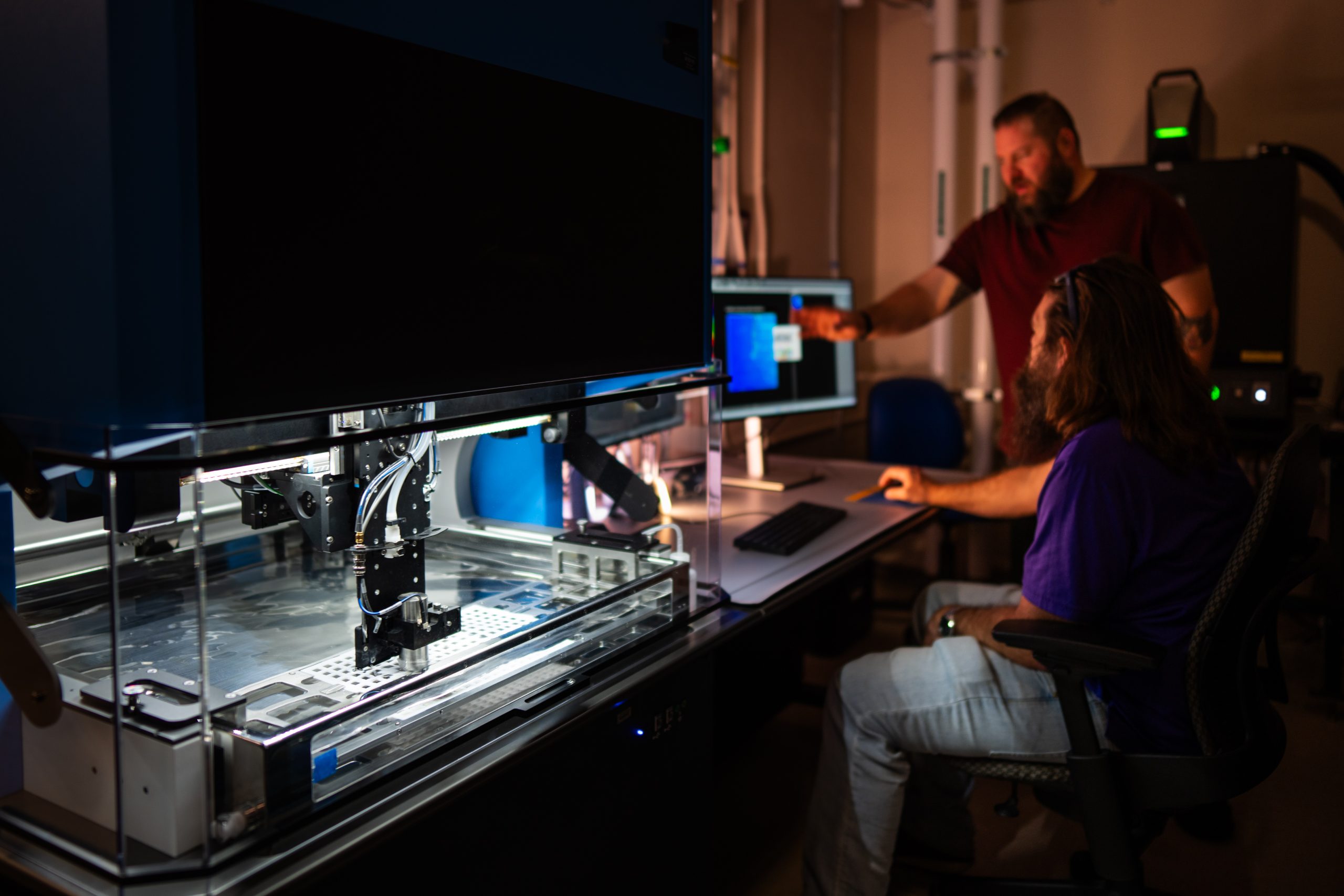
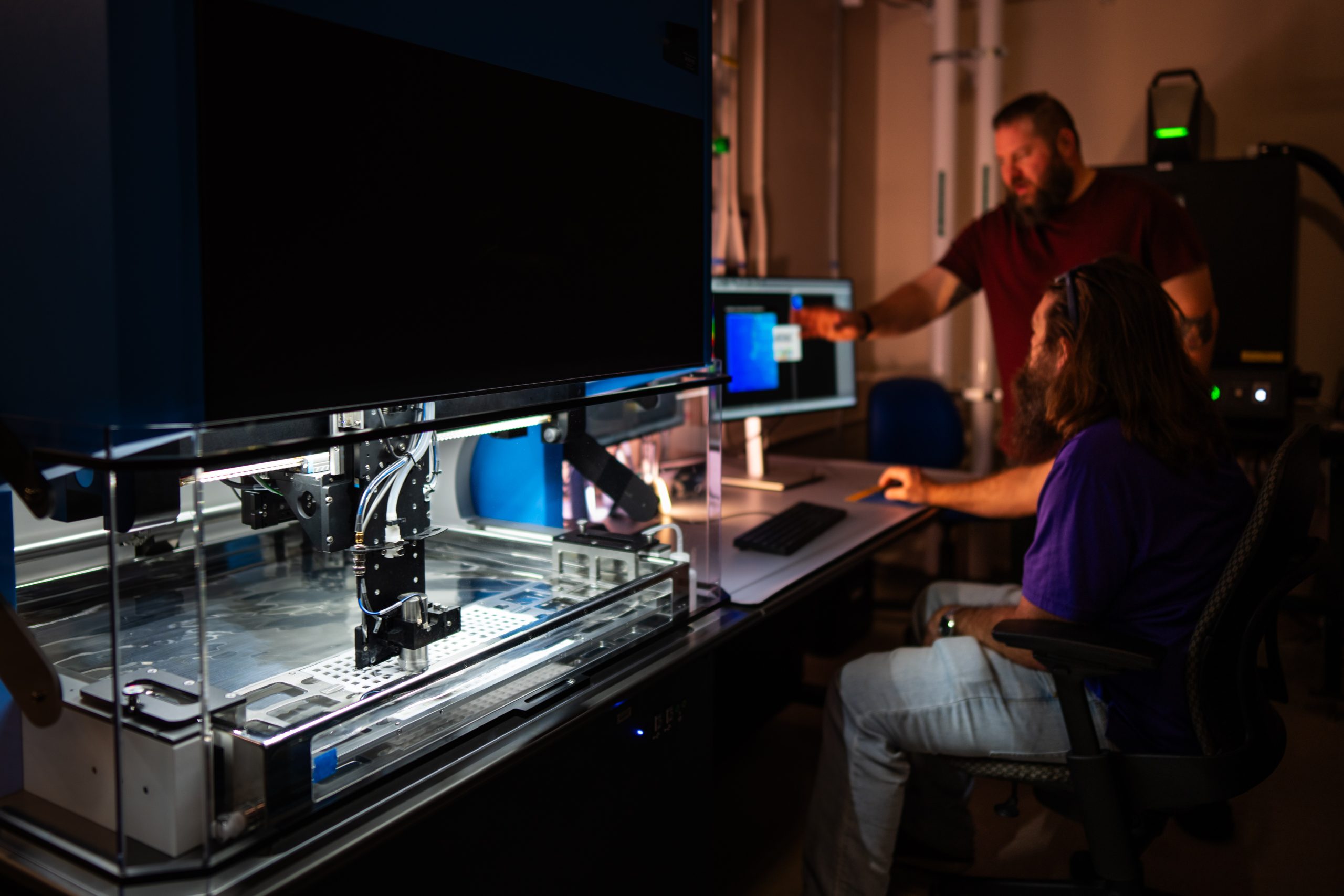
Staff at Sandia National Laboratories work to set up a new ultrasonic tool that will use artificial intelligence to inspect ceramics components used in nuclear deterrence applications, replacing a time-consuming manual method.

Credits

Photo by Craig Fritz

Caption

A technician at Sandia National Laboratories reviews a scanned image of a ceramic billet from her desktop. Sandia is transitioning from using a manual inspection to one that uses artificial intelligence to flag defects. Technicians will still review the results for quality control.

Credits

Photo by Craig Fritz

Caption

Technicians at Sandia National Laboratories use a small wand of light and a microscope to manually inspect ceramic components for tiny defects. The process is time-consuming, challenging on the eyes and requires extensive training. With the introduction of artificial intelligence and new equipment, inspections will take place earlier in the production process.

Credits

Photo by Craig Fritz

<strong>Staff at Sandia National Laboratories work to set up a new ultrasonic tool that will use artificial intelligence to inspect ceramics components used in nuclear deterrence applications, replacing a time-consuming manual method. </strong>(Photo by Craig Fritz) Click on the thumbnail for a high-resolution image.
Staff at Sandia National Laboratories work to set up a new ultrasonic tool that will use artificial intelligence to inspect ceramics components used in nuclear deterrence applications, replacing a time-consuming manual method. (Photo by Craig Fritz) Click on the thumbnail for a high-resolution image.

ALBUQUERQUE, N.M. — At Sandia National Laboratories, a new inspection workflow is taking shape that could help catch tiny defects earlier in the manufacturing process for ceramic components.

“We manufacture ceramic components for nuclear deterrence applications,” said process engineer Jesse Adamczyk, who is leading the project. “We realize there’s a big opportunity here.”

Teams from across the Labs are installing new optical and acoustic imaging systems and building an AI-assisted review tool designed to speed inspections while keeping people firmly in the loop.

“We do manual inspections of all our parts. It is extremely time-consuming,” Adamczyk said. “These parts go into various weapon systems.”

AI inspections

The project begins by scanning ceramic billets, the starter pieces that are later manufactured into finished components, using high-throughput imaging systems that create detailed digital records of each billet.

“It’s pricey to get billets to their final component,” Adamczyk said. “If we can identify defects at the billet level, we don’t put all that work into manufacturing the final component.”

The earlier inspections will save time and money.
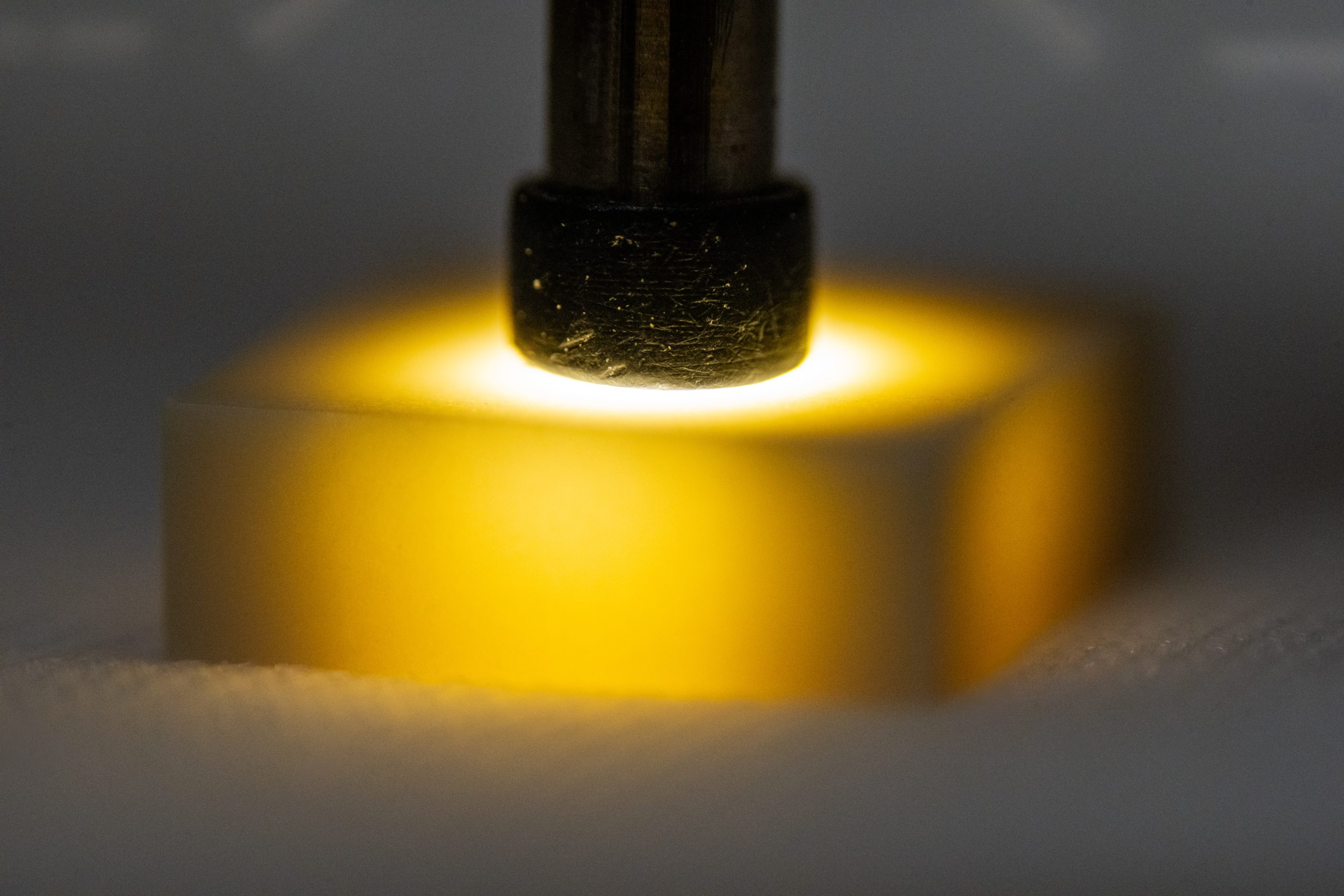
<strong>Technicians at Sandia National Laboratories use a small wand of light and a microscope to manually inspect ceramic components for tiny defects. The process is time-consuming, challenging on the eyes and requires extensive training. With the introduction of artificial intelligence and new equipment, inspections will take place earlier in the production process. </strong>(Photo by Craig Fritz) Click on the thumbnail for a high-resolution image.
Technicians at Sandia National Laboratories use a small wand of light and a microscope to manually inspect ceramic components for tiny defects. The process is time-consuming, challenging on the eyes and requires extensive training. With the introduction of artificial intelligence and new equipment, inspections will take place earlier in the production process. (Photo by Craig Fritz) Click on the thumbnail for a high-resolution image.

Right now, inspectors rely heavily on manual microscopes for inspecting final components. It takes one to two years to fully train an operator on the manual inspection process, which is time-consuming and challenging on the eyes.

The new approach for final components is designed to shift that work to a digital workflow in which images can be reviewed at a workstation.

“Right now, an operator looks through a manual microscope for defects. They’re subtle, so they can be hard to find,” Adamczyk said. “We’re setting up software — an AI augmentation interface — where operators can do anomaly detection from their desktops and have AI highlight defects for them.”

Adamczyk emphasized that inspections will not rely solely on AI.

“Operators will double-check to make sure the AI is highlighting real defects, and if there’s a defect AI misses, the operator will catch it,” he said. “AI augmentation is going to be more effective than manual visual inspection and more effective than just letting the AI run loose.”

Adamczyk said this is a big shift, but operators are embracing it to help meet demand.

“They are thrilled to have these technologies coming online, and they’re not going to be replaced. They’re going to be reassigned because we have more work coming into our production floor,” Adamczyk said.

Sandia National Laboratories is transitioning from manual inspections for ceramics components for nuclear deterrence applications to using artificial intelligence to help flag anomalies. (Video by Ruth Frank) Members of the media may click on the video to download and use for illustrative purposes.

The processes will be set up so that while the components are scanned, operators can work on other tasks. The AI augmentation for active ceramics demonstrates what the Department of Energy’s Genesis Mission is designed to accomplish: tackle the nation’s most complex science and technology challenges using AI. In this case, it helps speed up the nuclear deterrence mission.

Looking ahead

Adamczyk said the next few months will be busy on the production floor with the upgrades. In addition to tool installation, engineers are working to develop processes for imaging systems and software for the AI-augmented inspections.
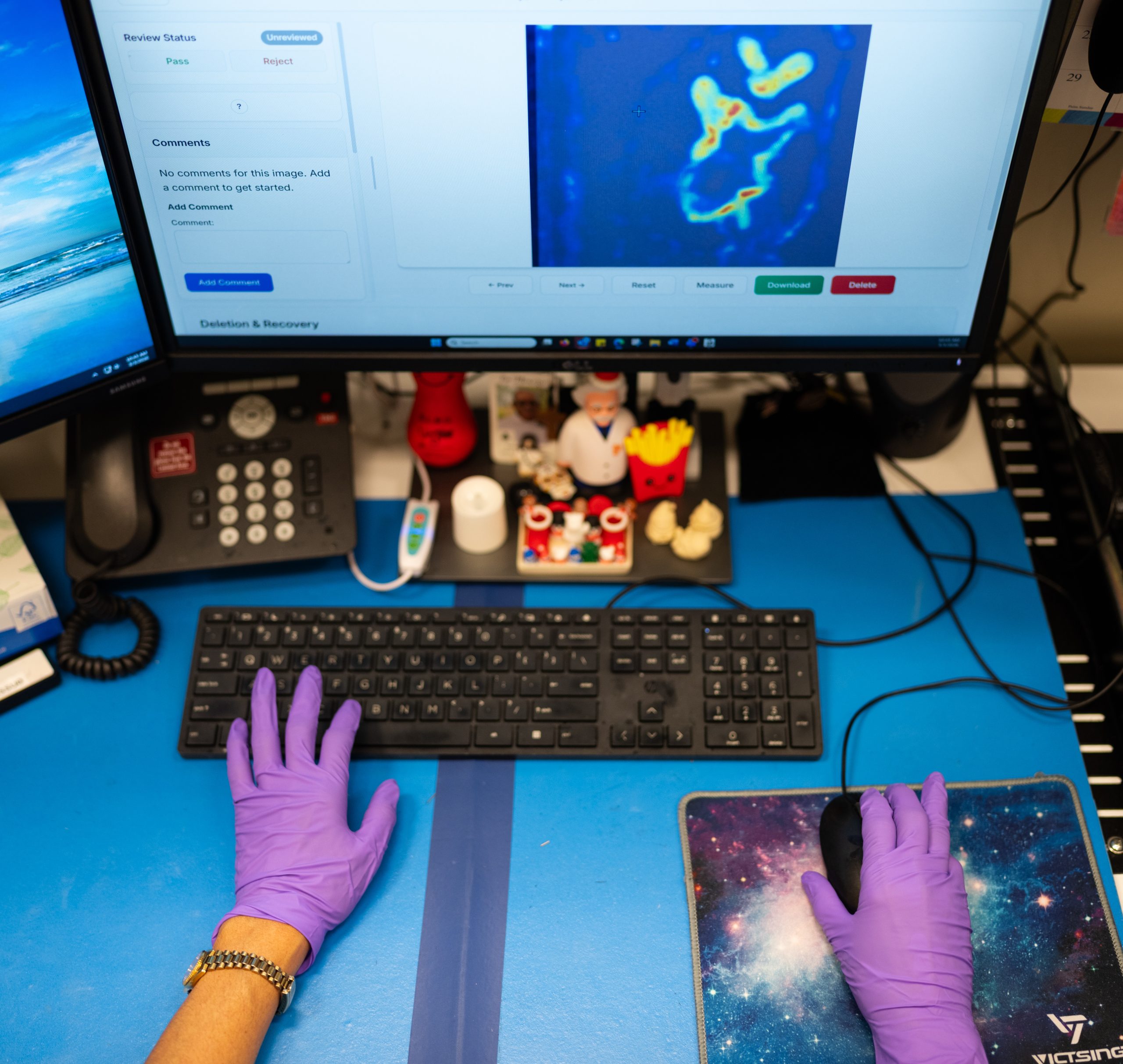
<strong>A technician at Sandia National Laboratories reviews a scanned image of a ceramic billet from her desktop. Sandia is transitioning from using a manual inspection to one that uses artificial intelligence to flag defects. Technicians will still review the results for quality control. </strong>(Photo by Craig Fritz) Click on the thumbnail for a high-resolution image.
A technician at Sandia National Laboratories reviews a scanned image of a ceramic billet from her desktop. Sandia is transitioning from using a manual inspection to one that uses artificial intelligence to flag defects. Technicians will still review the results for quality control. (Photo by Craig Fritz) Click on the thumbnail for a high-resolution image.

During a visit to the lab one afternoon, employees were eagerly collaborating and learning how the new equipment works, including a recently installed acoustic imaging system. Over the next few months, work documentation will be developed and released, and employees will be trained on the updated processes.

“We have a lot of support for this at the management and leadership level. I have a tremendous team helping,” Adamczyk said. “We’re trying to deploy this workflow on our production floor as an exemplar and then take the same workflow and deploy it to other parts of Sandia and nuclear security enterprise sites. That’s the long-term goal.”

The new imaging systems and AI augmentation tool are scheduled to be up and running by early fall. The National Nuclear Security Administration’s AI for Nuclear Security initiative, led by the Office of Advanced Simulation and Computing, is funding the project.


Sandia National Laboratories is a multimission laboratory operated by National Technology and Engineering Solutions of Sandia LLC, a wholly owned subsidiary of Honeywell International Inc., for the U.S. Department of Energy’s National Nuclear Security Administration. Sandia Labs has major research and development responsibilities in nuclear deterrence, global security, defense, energy technologies and economic competitiveness, with main facilities in Albuquerque, New Mexico, and Livermore, California.

Sandia news media contact

Kenny Vigil
kcvigi@sandia.gov
505-537-1528