
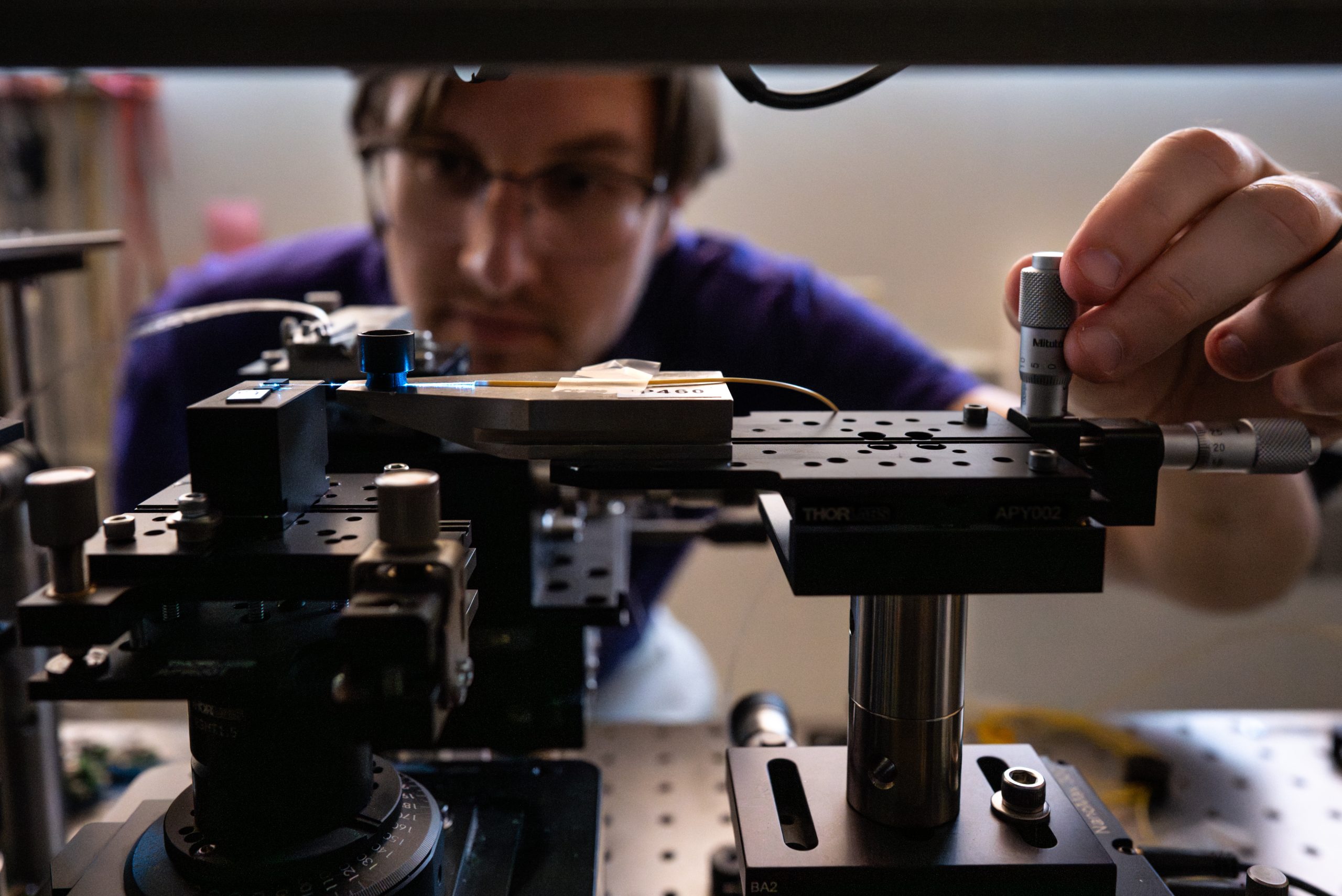
ALBUQUERQUE, N.M. — A public-private partnership in the Mountain West announced today new results that mark steady progress toward the Department of Energy’s goal of fault-tolerant quantum computing, systems large and reliable enough to solve complex problems.
Sandia National Laboratories, home to the DOE’s longest running quantum computing program, and tech company Quantinuum published a paper today in the scientific journal Nature that reports the performance of the company’s 98-qubit commercial system, Helios, which debuted last year.
In operations that involved only one or two qubits, or quantum bits, the system demonstrated very high fidelity — 99.9975% and 99.921%, respectively. The results establish Helios as the company’s largest and most reliable quantum computer to date.
Sandia senior manager Mike Descour lauded the findings as a success for the laboratory’s collaboration efforts within the quantum computing sector.
“As a national resource, we are committed to accelerating quantum computing technology in support of economic and national security,” he said.
Sandia, the nation’s premier engineering laboratory, assesses emerging opportunities and threats stemming from quantum information science for the U.S. government. These areas include cryptography, pharmaceutical research, energy science, advanced sensing and communications, all of which are key to national security.
The paper was previously posted to the pre-print website arXiv. The new version in Nature has been peer reviewed, meaning the findings now have been scrutinized by third-party experts.
Ongoing partnership advancing scalable hardware
For more than 20 years, Sandia’s quantum computing research and development program has combined the labs’ engineering forte with expertise in computer modeling and world-class microelectronics and nanotechnology facilities to build, characterize and share working quantum devices on a variety of technology platforms.

Throughout this time, Sandia has grown its portfolio of industry partnerships. The labs and Quantinuum have been working together for four years under a Cooperative Research and Development Agreement, which was renewed in May. Similar agreements are in place with several other quantum computing companies.
“We welcome collaboration with any interested partner including universities, industry and other national laboratories,” said Sandia photonics manager Chris DeRose.
The partnership initially formed a few years after Sandia researchers had started developing foundational technologies in integrated photonics for trapped ion quantum computers, the same style as Helios, at Sandia’s Microsystems Engineering, Science and Applications complex.
Integrated photonics are energy-efficient chips that carry information at the speed of light through microscopic optical channels. They promise to reduce the risks of quantum technology by lowering energy costs and improving scalability, which is key to building large, useful computers.
Now, Sandia helps Quantinuum design and test these kinds of components for possible inclusion in future platforms.
Quantinuum, which has its corporate headquarters located in Colorado, operates a research and development site in New Mexico, close to Sandia’s main campus.
Sandia conducted Helios assessment
In the Nature paper, Sandia evaluated and certified the performance of the Helios system.
The national laboratory has pioneered ways to debug quantum computers and used a variety of tests, including some of its own inventions, to assess Helios. Its researchers supplied a new benchmarking methodology to measure the performance of non-destructive readout operations, called mid-circuit measurements, that are essential for correcting quantum computing errors.
“The most important aspect of today’s quantum computers is not speed, but reliability,” said Sandia’s Robin Blume-Kohout, a co-author on the paper. Quantum computers use complex, experimental technologies that can fail in dozens of subtle ways, he explained, from an out-of-tune laser giving bad instructions to a single atom jiggling out of place. These problems degrade fidelity and limit performance.
In the long term, Blume-Kohout said, helping companies solve these issues will help bring about quantum computers that can tackle unsolved scientific problems.
“We evaluate every aspect of quantum computer performance with our commercial partners to accelerate the advent of quantum supercomputing,” he said.
In the near term, the new research results show the nation is reaching significant milestones along that path.
“Helios operates beyond the capabilities of classical simulation alone and established a new benchmark of fidelity and complexity for quantum computers,” said Quantinuum’s Tony Ransford, Helios lead architect.
Please visit our website for more information about how Sandia partners with quantum computing companies.