
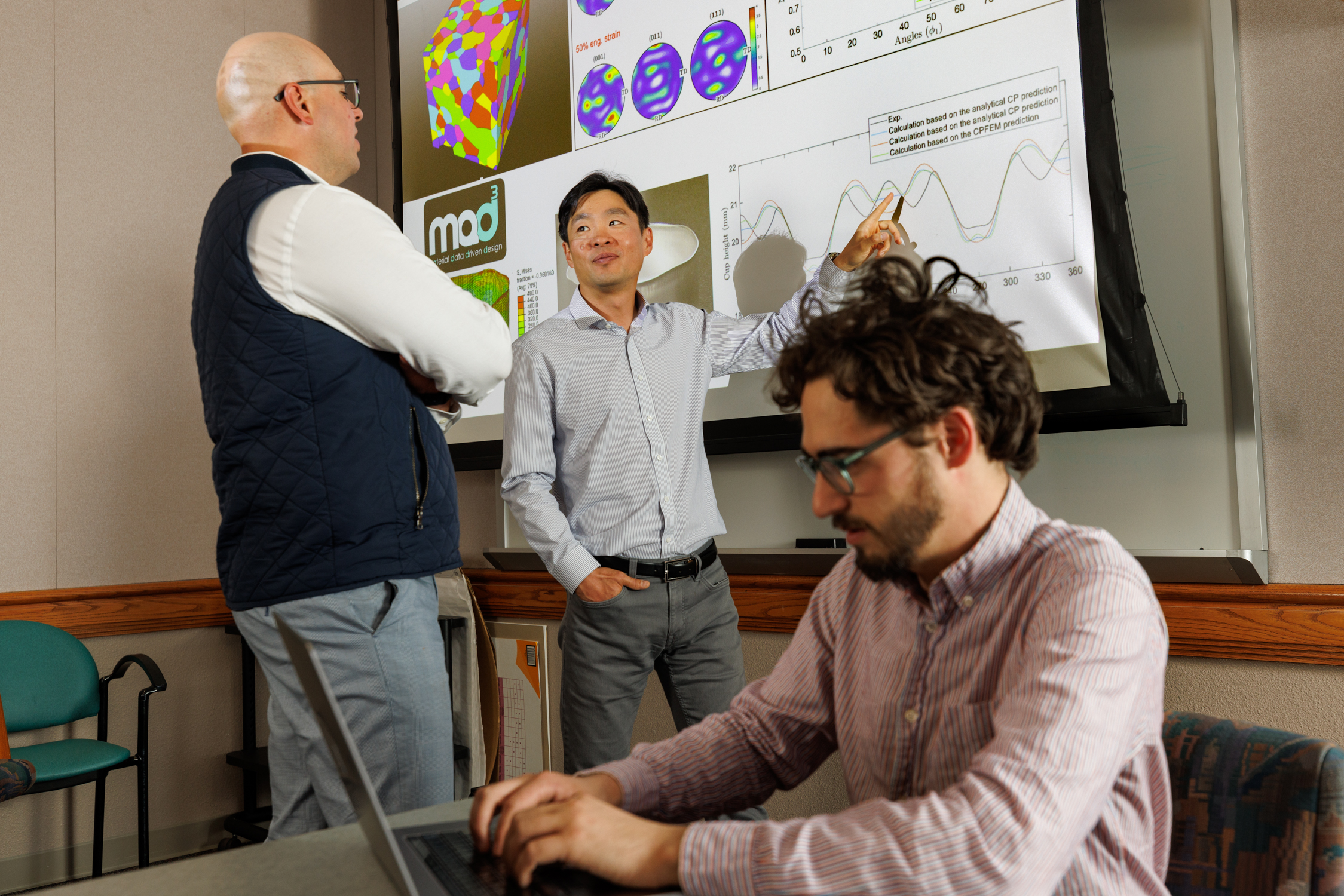
ALBUQUERQUE, N.M. — When Sandia National Laboratories researchers Hojun Lim and David Montes de Oca Zapiain began working on software to accelerate materials simulations, they started with just an idea. Now, eight years later, they have award-winning, ready-to-use software they believe can revolutionize manufacturing.
Materials Data Driven Design, or MAD³ combines machine learning and materials science to predict, in minutes, how metals deform in real-world manufacturing scenarios. It’s a tool they say could have a major impact on automotive, aerospace and metal manufacturing as well as academia and research labs.
“It’s exciting to take something that was developed from the research scope and see it transition all the way to a ready-to-use product,” Montes de Oca Zapiain said.
While MAD³ has been used on various projects across Sandia, the goal is to get it licensed and into the hands of companies around the country to advance and accelerate American manufacturing.
Manufacturing challenges
Companies can spend millions of dollars a year on simulations, experiments and testing to ensure the materials they choose can be shaped into their designed components.
“Metals are made up of micro-sized grains or crystals, and their orientation determines directional or mechanical strength, commonly referred to as plastic anisotropy,” Lim said. “When you apply a force to a material in different directions, you will see a varying response in the deformation, and that directly influences a material’s strength, failure or formability. In manufacturing, the ability to form or shape parts from sheet metal heavily relies on understanding these properties.”
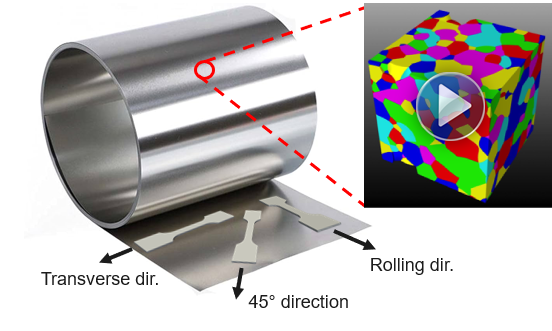
Metals are made up of micro-sized grains or crystals whose orientation determines directional or mechanical strength, commonly referred to as plastic anisotropy. (Graphic courtesy of David Montes de Oca Zapiain and Hojun Lim) Click to watch the animation.
Performing experiments is still considered the most accurate way to determine material properties, but it’s costly and, in many cases, impractical.
“You do not build a whole engine, plane or car when trying to change one component,” Montes de Oca Zapiain said.
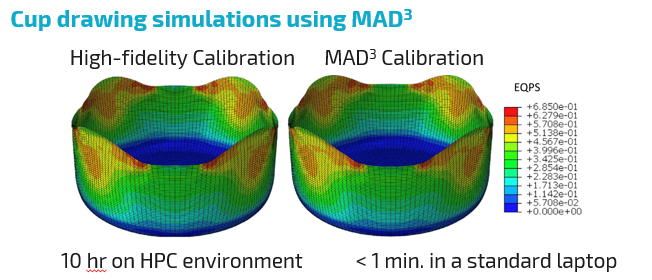
For that reason, many companies use high-fidelity computer simulations to perform virtual tests. But these tests can be cumbersome. They require extensive computing, take weeks to perform, and require access to supercomputers and experts who know how to run them.
That is why Montes de Oca Zapiain and Lim built MAD³. The pair combined their materials science and AI background to create something they believe can be revolutionary.
“We are targeting the verified pain points in industry,” Montes de Oca Zapiain said. “With MAD³ you are getting fast and accurate solutions with the help of machine learning. You just run your data, and in a couple of seconds, you get results.”
What makes MAD³ different
MAD³ is different from other simulation software because it leverages machine learning and materials science techniques to improve speed while maintaining accuracy. It extracts knowledge from 70,000 high-fidelity simulations using deep learning — more specifically, a variational Bayesian inference neural network model. MAD³ is ready to use on any operating system and doesn’t require users to know how to code.
“Our main goal was to make it as easy to use as possible,” Lim said. “Anyone can use it.”
Montes de Oca Zapiain and Lim say that, in its most basic form, MAD³ can drastically cut costs and time for manufacturers. They have also recently developed the software further to perform at even higher levels and incorporate new metal alloys.
“With its initial capability, we could tell you what deformation capabilities a material would have. Now we can do the inverse,” Montes de Oca Zapiain said. “If you specify a target property, we can determine the optimal internal structure.”
Lim and Montes de Oca Zapiain are exploring potential partnerships with a major American automotive manufacturer, an aeronautics company, a defense and cyberspace company, and an aircraft engine designer and manufacturer.
They say the software is adapted to meet manufacturing needs, a result of years of research and development and conversations with 120 potential customers.
“We learned a lot from doing interviews and getting feedback,” Lim said. “It really opened our eyes to see what is really needed on the manufacturing side. This application is based not only on a scientific point of view but also on suggestions and feedback from experts in industry, academia and national labs.”
“We learned that great ideas don’t always make great products,” Montes de Oca Zapiain said. “This was a product created through a customer discovery process.”
Award winning invention
Montes de Oca Zapiain and Lim received an R&D 100 Award for MAD³ in 2023, a significant honor. But they’re eager to see their invention at work in American industry.
MAD³ is now available for licensing from Sandia.
Montes de Oca Zapiain and Lim hope it can revolutionize manufacturing.
“It’s been a really illuminating journey,” Montes de Oca Zapiain said. “If we kept going with just the science, it would have gone in a different direction. The software is focused on what’s being experienced in industry. We are targeting those pain points.”
“I think this was my first time getting some of my work out of my computer and sharing it with many people. So, it was a very rewarding experience,” Lim said.
MAD³ was featured on the Department of Energy’s National Lab Discovery series in January 2026.