Sandia recreates flight-like heat to support NASA’s Dragonfly mission to Titan

Final solar-tower tests qualify the heat shield system and expand a capability that also supports Sandia’s nuclear deterrence mission

Publication Date:

Sandia news media contact

Kristen Meub
klmeub@sandia.gov
505-845-7215

Media Downloads

Caption

The mirror-like heliostat field at Sandia National Laboratories’ National Solar Thermal Test Facility can rotate into the exact position needed to reflect and concentrate sunlight for each test.

Credits

GIF by Craig Fritz

Caption

A time lapse of a heat shield test at Sandia National Laboratories’ National Solar Thermal Test Facility. The heliostat field focused sunlight onto a 24-inch area of test material mounted at the top of the solar tower, delivering a controlled heat pulse exceeding 4,500 degrees Fahrenheit. The team also flowed inert gas over the sample to better approximate Titan’s atmosphere.

Credits

GIF by Craig Fritz

Caption

A close look at the heat shield sample, mounted inside the white container. It was exposed to extreme heat through a beam of concentrated sunlight at Sandia National Laboratories’ National Solar Thermal Test Facility.

Credits

GIF by Craig Fritz

Caption

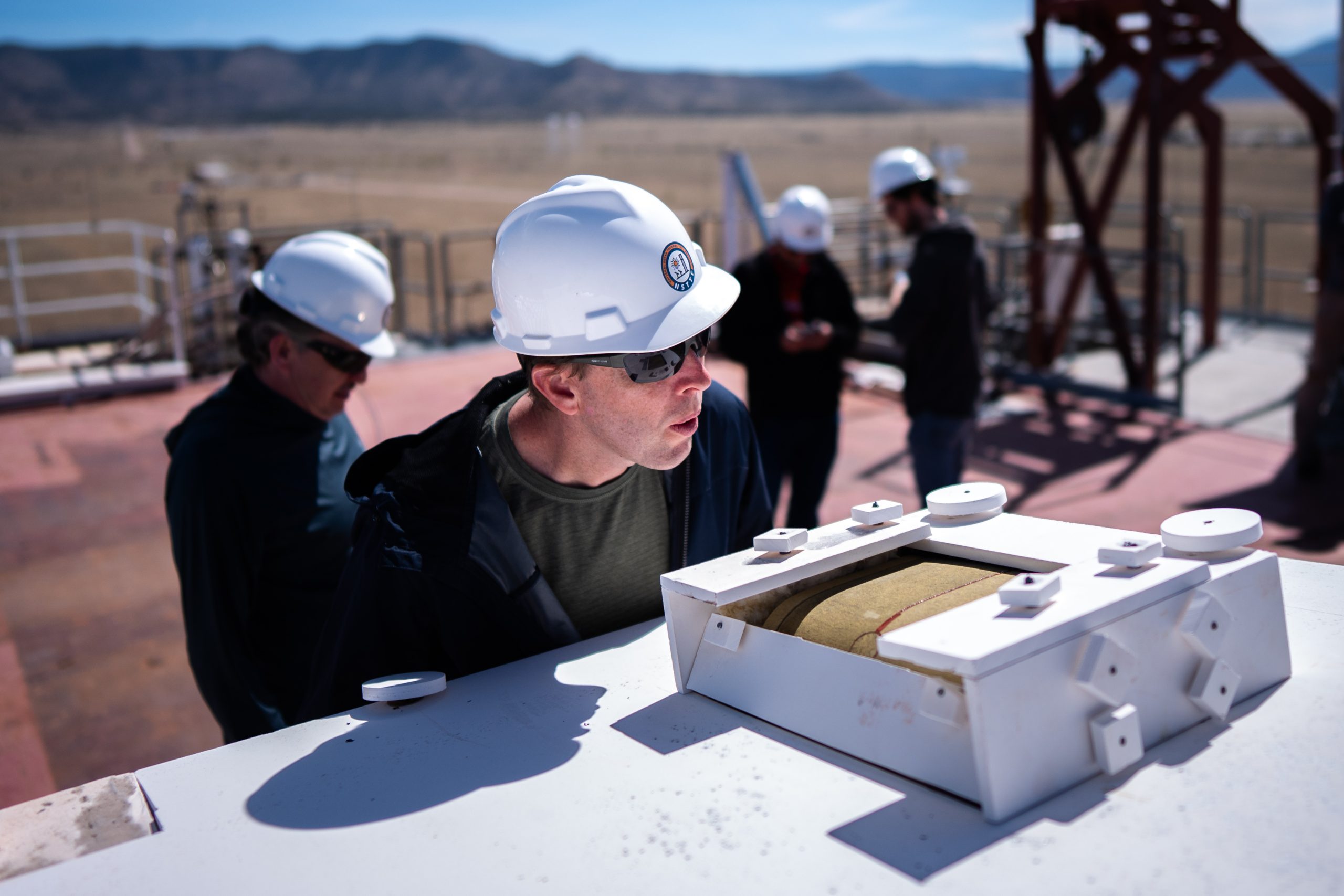
Lockheed Martin engineer Derek Shannon checks a sample of heat shield material before a test at Sandia National Laboratories’ National Solar Thermal Test Facility.

Credits

Photo by Craig Fritz

Caption

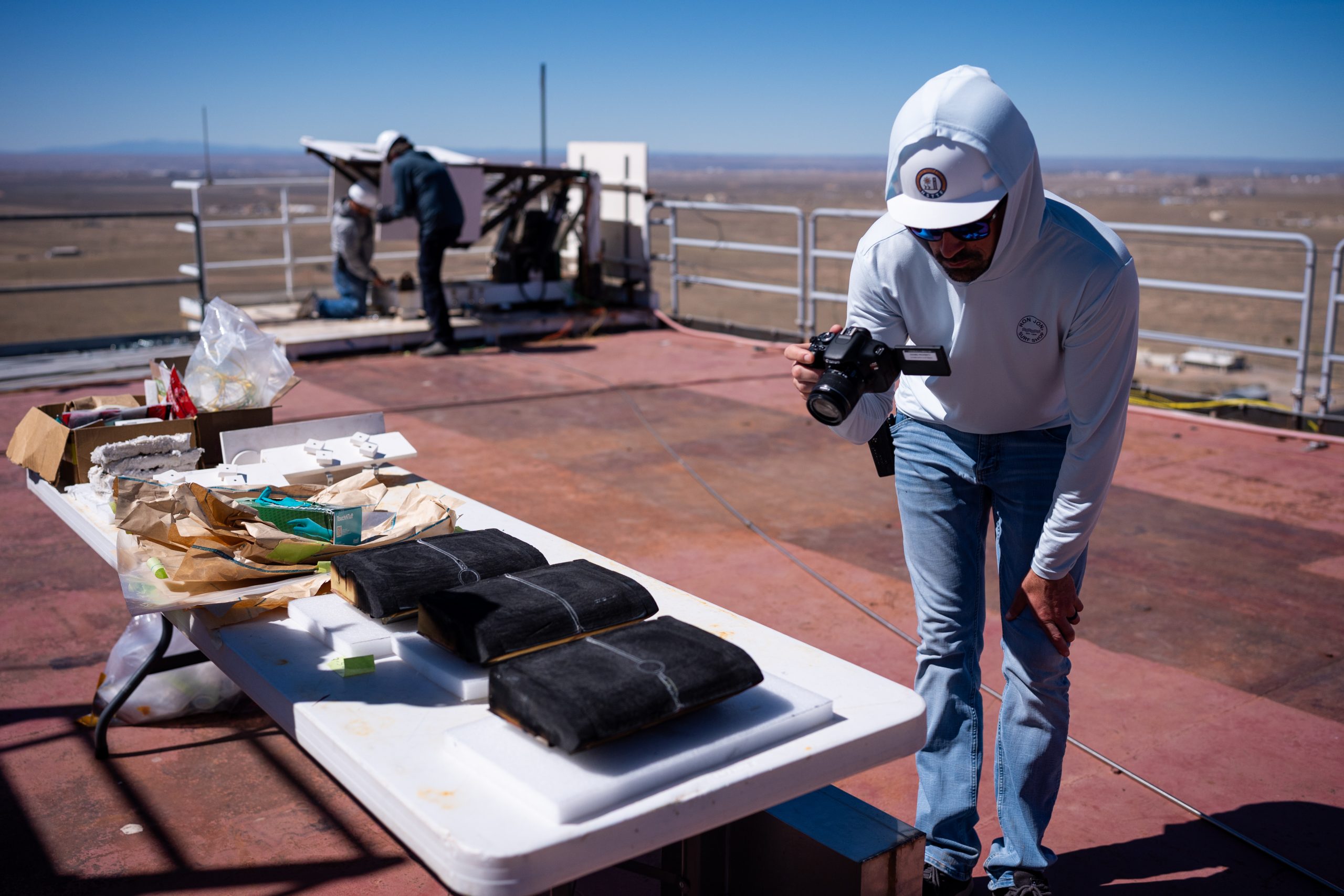
Lockheed Martin engineer Nick Courtney photographs samples of heat shield material after testing at Sandia National Laboratories’ National Solar Thermal Test Facility.

Credits

Photo by Craig Fritz

Caption

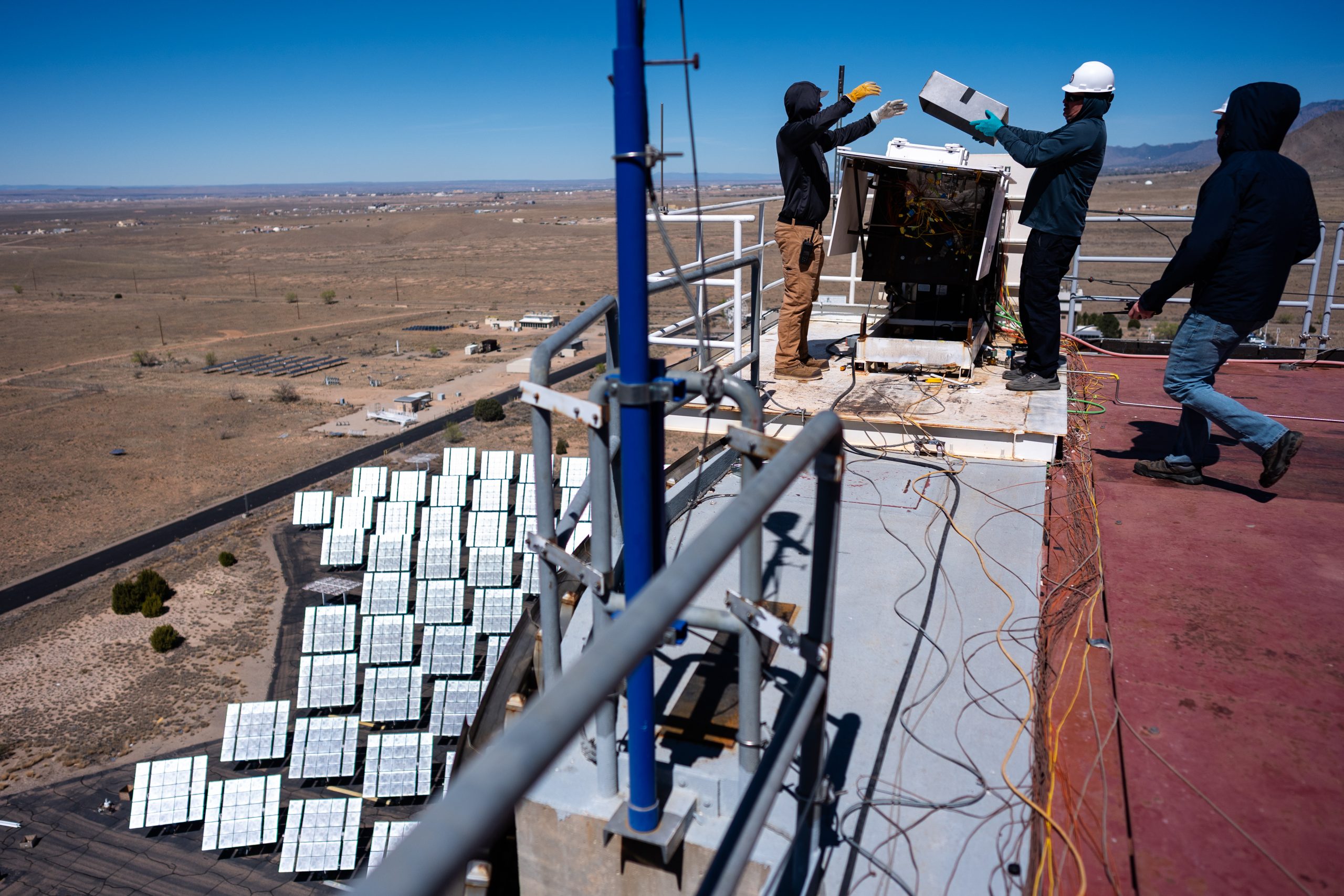
Sandia National Laboratories engineers Aaron Overacker, left, Todd Arterburn, and Lockheed Martin engineer Derek Shannon, right, get ready to test heat shield material samples at the National Solar Thermal Test Facility for NASA’s Dragonfly mission to Titan.

Credits

Photo by Craig Fritz

Caption

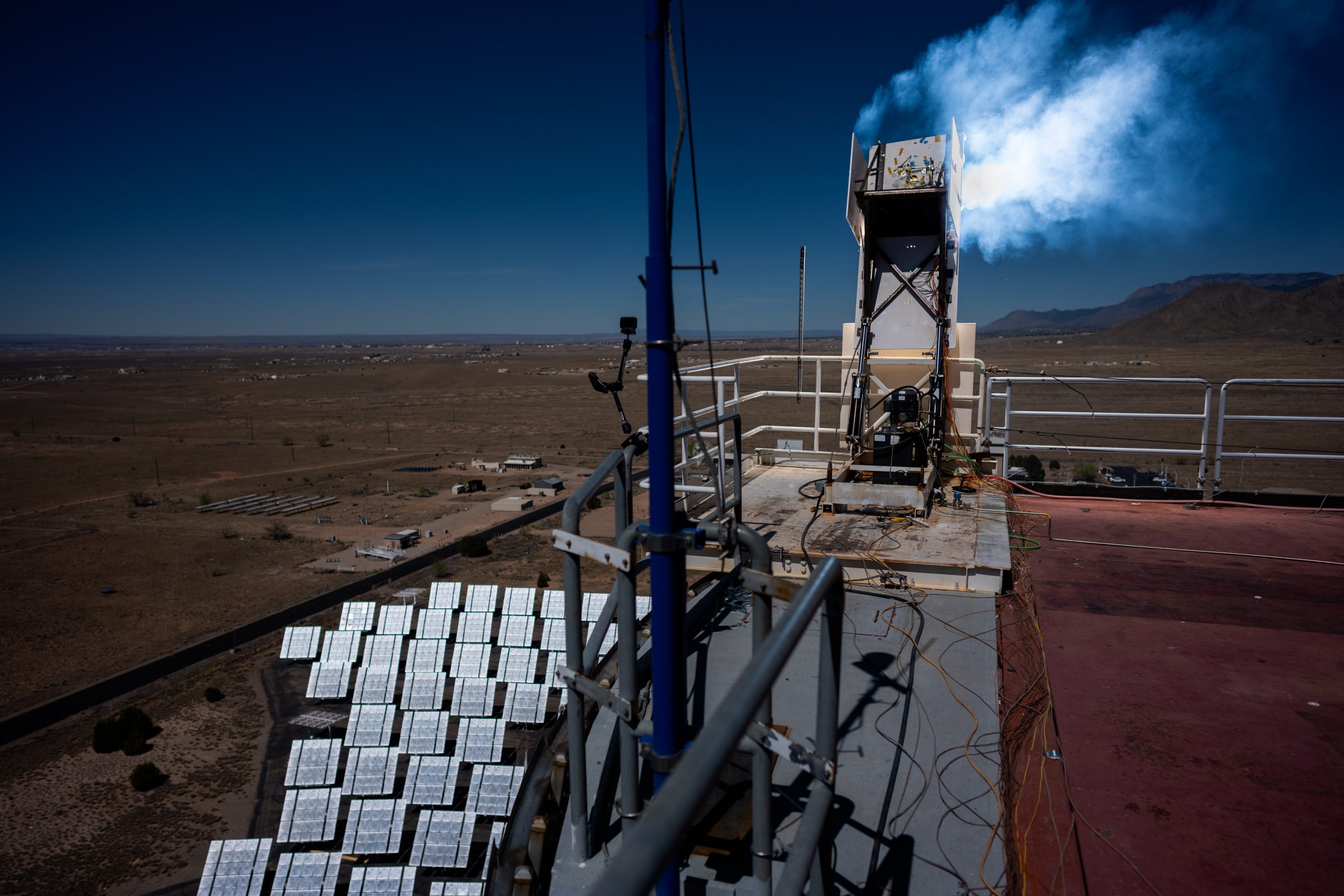
Hundreds of mirror-like heliostats concentrate sunlight on a sample of heat shield material at Sandia National Laboratories’ National Solar Thermal Test Facility. The material, developed by NASA’s Ames Research Center in California's Silicon Valley for the Dragonfly mission, was subjected to a pulse of heat that exceeded 4,500 degrees Fahrenheit.

Credits

Photo by Craig Fritz

Caption

A close look at the heat shield sample, mounted inside the white container. It was exposed to extreme heat through a beam of concentrated sunlight at Sandia National Laboratories’ National Solar Thermal Test Facility.

Credits

Video by Craig Fritz

Caption

A time lapse of a heat shield test at Sandia National Laboratories’ National Solar Thermal Test Facility. The heliostat field focused sunlight onto a 24-inch area of test material mounted at the top of the solar tower, delivering a controlled heat pulse exceeding 4,500 degrees Fahrenheit. The team also flowed inert gas over the sample to better approximate Titan’s atmosphere.

Credits

Video by Craig Fritz

Caption

The mirror-like heliostat field at Sandia National Laboratories’ National Solar Thermal Test Facility can rotate into the exact position needed to reflect and concentrate sunlight for each test.

Credits

Video by Craig Fritz

ALBUQUERQUE, N.M. — When NASA sends Dragonfly to explore Titan, Saturn’s largest moon, the first-of-its-kind rotorcraft must first survive a roughly two-hour plunge through Titan’s dense, nitrogen-rich atmosphere. During that fiery descent, friction and compression will generate intense heat as Dragonfly decelerates toward the surface.

At Sandia National Laboratories’ National Solar Thermal Test Facility, engineers helped NASA prepare for that critical phase by recreating flight-like heating on large test articles to qualify Dragonfly’s heat shield thermal protection system. Sandia and NASA recently completed the sixth and final solar-tower test campaign at the facility, capping a multiyear effort that began in 2023. The work also expanded a repeatable high-heat testing capability that benefits Sandia’s nuclear deterrence mission.
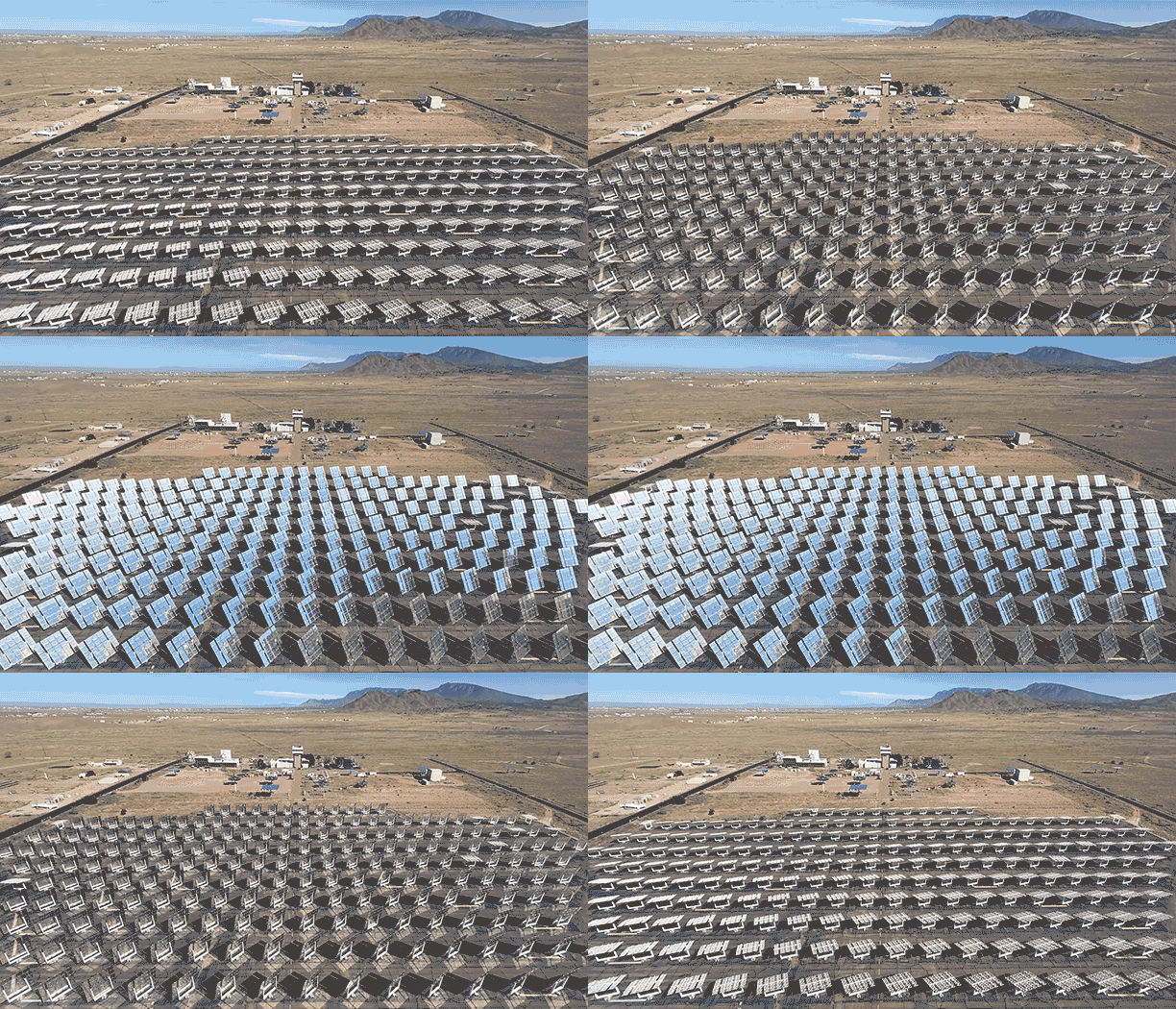
<strong>The mirror-like heliostat field at Sandia National Laboratories’ National Solar Thermal Test Facility can rotate into the exact position needed to reflect and concentrate sunlight for each test.</strong> (GIF by Craig Fritz)
The mirror-like heliostat field at Sandia National Laboratories’ National Solar Thermal Test Facility can rotate into the exact position needed to reflect and concentrate sunlight for each test. (GIF by Craig Fritz)

During each visit, the team conducted four to eight tests, evaluating different heat shield segments under flight-like heating conditions. Each test began with the team mounting a heat shield segment at the top of Sandia’s 200-foot solar tower on a fixture that allowed engineers to vary its orientation, including the angle at which concentrated sunlight struck the material. Operators then aimed the facility’s hundreds of mirror-like heliostats to focus sunlight onto a 24-inch area, delivering a controlled heat pulse that could exceed 4,500 degrees Fahrenheit, well above the predicted conditions for Dragonfly’s Titan entry. The team also flowed inert gas over the heat shield sample to better approximate Titan’s atmosphere.
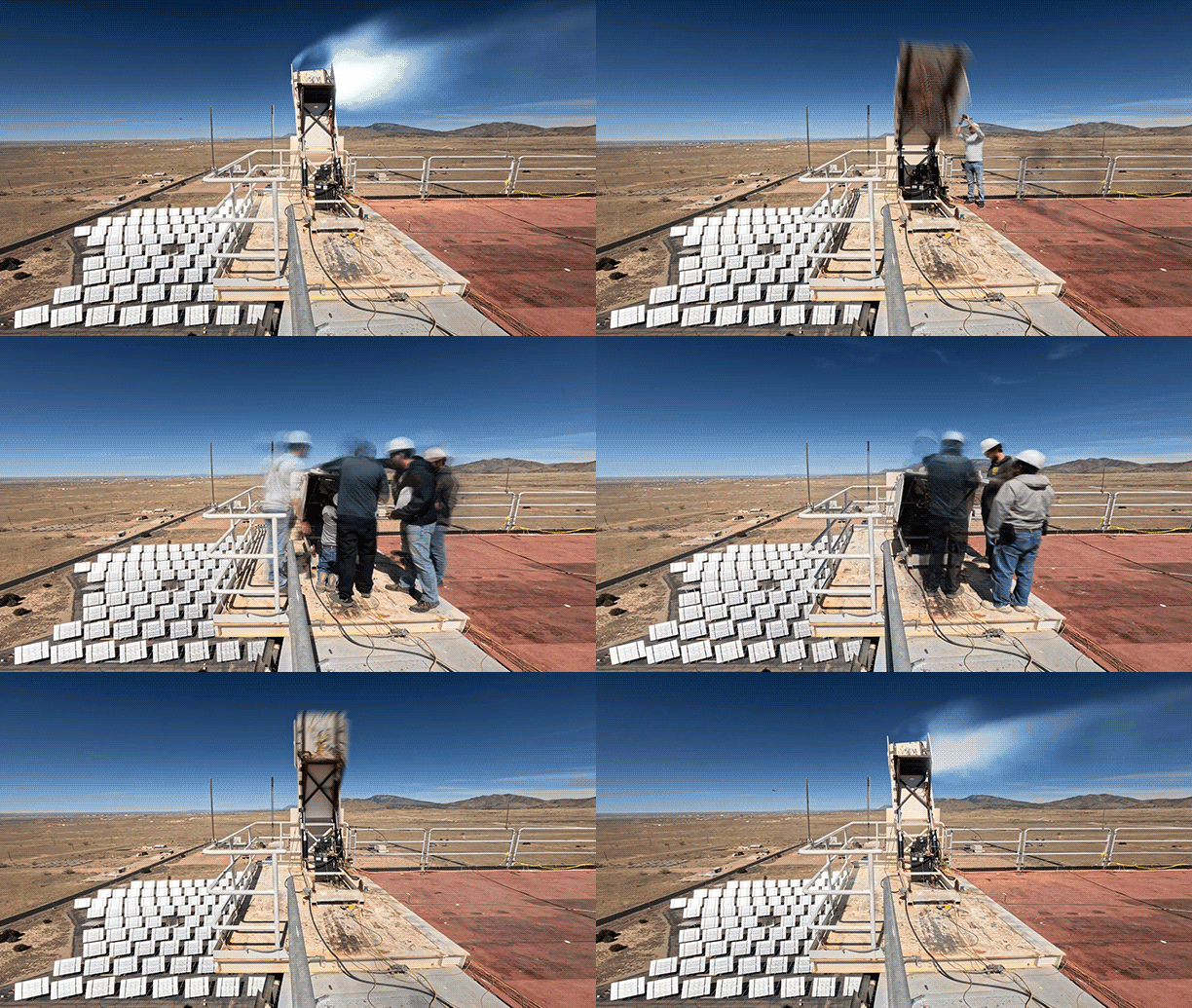
<strong>A time lapse of a heat shield test at Sandia National Laboratories’ National Solar Thermal Test Facility. The heliostat field focused sunlight onto a 24-inch area of test material mounted at the top of the solar tower, delivering a controlled heat pulse exceeding 4,500 degrees Fahrenheit. The team also flowed inert gas over the sample to better approximate Titan’s atmosphere.</strong> (GIF by Craig Fritz)
A time lapse of a heat shield test at Sandia National Laboratories’ National Solar Thermal Test Facility. The heliostat field focused sunlight onto a 24-inch area of test material mounted at the top of the solar tower, delivering a controlled heat pulse exceeding 4,500 degrees Fahrenheit. The team also flowed inert gas over the sample to better approximate Titan’s atmosphere. (GIF by Craig Fritz)

The heat shield material charred and smoked under the intense heat. Infrared cameras and other instruments recorded how heat moved across curved shoulders, edges and gaps in the material.

“We are able to simulate the heating profile on a physical scale and time scale that’s meaningful for flight, using concentrated sunlight to deliver repeatable tests, independent validation and opportunities to iterate,” said Ken Armijo, Sandia’s lead engineer and test director for the campaign. “These tests help build confidence in the heat shield system before it ever flies.”
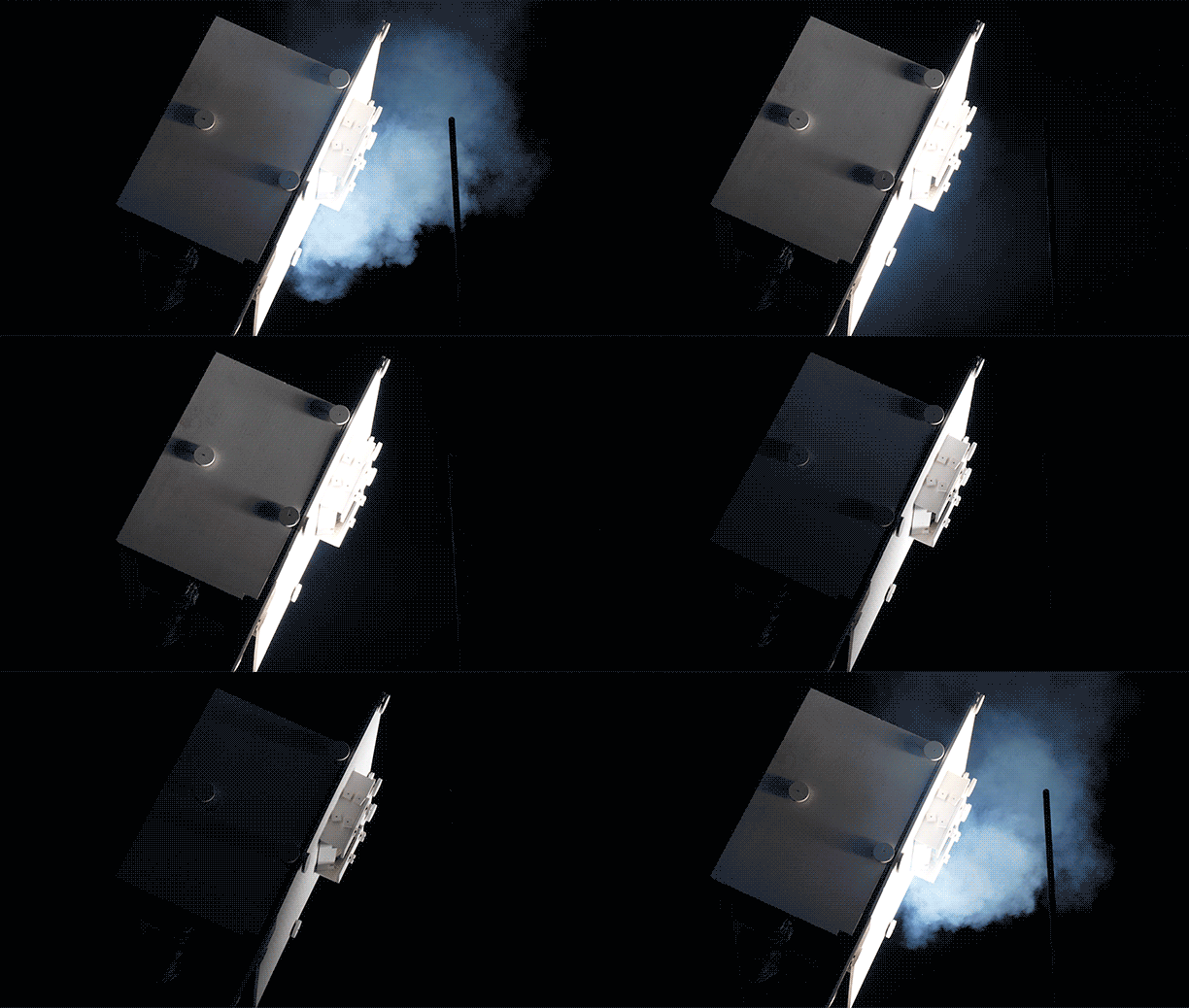
<strong>A close look at the heat shield sample, mounted inside the white container. It was exposed to extreme heat through a beam of concentrated sunlight at Sandia National Laboratories’ National Solar Thermal Test Facility.</strong> (GIF by Craig Fritz)
A close look at the heat shield sample, mounted inside the white container. It was exposed to extreme heat through a beam of concentrated sunlight at Sandia National Laboratories’ National Solar Thermal Test Facility. (GIF by Craig Fritz)

Dragonfly’s heat shield system is part of the spacecraft’s entry, descent and landing assembly, designed to protect it during atmospheric entry. The heat shield is made of PICA-D, or Phenolic Impregnated Carbon Ablator-Domestic, a material developed by NASA’s Ames Research Center in California’s Silicon Valley.

NASA used the Sandia tests to examine how the heat shield material performed in multiple configurations, including flat segments, rounded shoulder segments and gap fillers. The team also tested pristine and intentionally marred samples to confirm the system can protect the spacecraft even if there are minor imperfections.

The NASA team said it selected Sandia’s National Solar Thermal Test Facility because it is the only ground qualification facility that can reproduce the predicted amount of heat Dragonfly will face on a test article large enough to generate flight-like stresses in the material. The team will use data from the tests to complete qualification work for Dragonfly’s heat shield system.

For Sandia, the Dragonfly campaign is more than a customer test series. As part of the NASA work, the team refined a test method that combines controlled solar heating, detailed diagnostics and inert gas flow to recreate entry-like environments at scale. The work expands Sandia’s options for evaluating materials and components for national security programs, including nuclear deterrence.

“This test series for NASA is not just leveraging Sandia’s engineering capabilities; it’s bolstering them,” Armijo said. “We’ve created new testing possibilities that also benefit our core nuclear deterrence mission as well as the commercial aerospace industry.”
 

Sandia National Laboratories is a multimission laboratory operated by National Technology and Engineering Solutions of Sandia LLC, a wholly owned subsidiary of Honeywell International Inc., for the U.S. Department of Energy’s National Nuclear Security Administration. Sandia Labs has major research and development responsibilities in nuclear deterrence, global security, defense, energy technologies and economic competitiveness, with main facilities in Albuquerque, New Mexico, and Livermore, California.

Sandia news media contact

Kristen Meub
klmeub@sandia.gov
505-845-7215